Fatih Akin Made a Coming-of-Age Film Set in the Nazi Era; A Project That Began as a Favor and Became an $8 Million Success

According to CinemaDrame News Agency, Fatih Akin brought the life story of his longtime friend and mentor, Hark Bohm (a veteran of the German New Wave), to the big screen before his passing in 2025, as a tribute to him.
Fatih Akin, the German-Turkish auteur based in Hamburg, has consistently reshaped narrative conventions with works such as “Head-On,” “Crossing the Bridge,” and the Cannes-winning film “The Edge of Heaven.” This year, the screening of his film “Amrum” at Cannes surprised everyone—including perhaps Thierry Frémaux, the festival director, who had not granted Akin his usual place in the competition section.
Speaking via video call from Hamburg, Akin said: “If I’m at the festival, I want the Palme d’Or emblem on the poster.” However, he ultimately emerged victorious when “Amrum” achieved an impressive $8 million at the German box office. (Akin is currently in post-production on a new film titled “Song of the Soul,” which he intends to prepare for Cannes; he describes it as a tragic love story and an artistic work aimed at teenagers.)
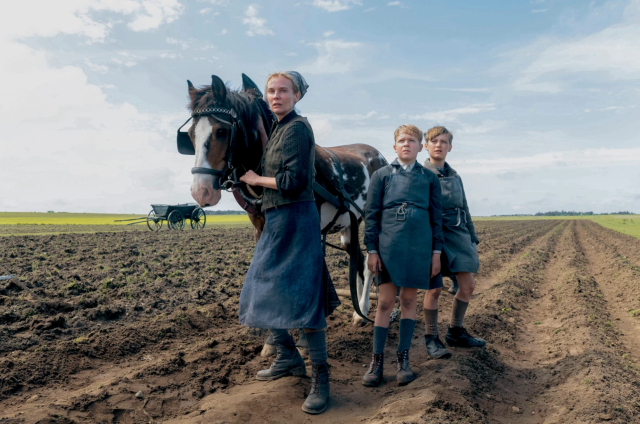
The story is set in the final year of World War II on the remote island of Amrum in the North Sea, told through the eyes of 12-year-old Nanning (played by Jasper Billerbeck), whose devout mother (Laura Tonke) raises him as a loyal Nazi while his father is away at war. When the mother falls into depression after childbirth—intensified by Hitler’s death—Nanning sets out to cheer her up by finding her favorite food (white bread, butter, and honey). His search across the island for these ingredients turns into a heroic journey.
Anyone familiar with Akin’s work will immediately notice that this film is crafted with a classical and minimalist aesthetic, differing from his usual energetic style. The reason is that Akin was initially supposed to produce the film for his longtime friend Hark Bohm (the eighty-year-old mentor and collaborator of Rainer Werner Fassbinder). Bohm’s experience as a judge had previously helped Akin write the screenplay for “In the Fade” (which won Diane Kruger the Best Actress award at Cannes 2017).
However, when Bohm fell ill, Akin first rewrote the story based on Bohm’s childhood memories in Amrum and then agreed to direct the project as well. Sadly, Hark Bohm passed away in November 2025.
At first, Akin intended to completely transform his artistic style as a tribute to his friend. He recalls thinking: “What am I doing here? I know nothing about this world. I don’t know how these people eat cake or drink coffee, and I know nothing about rural life.”
In the end, Akin said: “Alright, this is not my style, but he asked me, and I accepted.” He studied Bohm’s works scene by scene. But three weeks before filming began, he realized this approach was wrong. “I shouldn’t make the film the way he would. I have to make it my own way. In every film, I try to do something different; sometimes I succeed, sometimes I don’t.”
Thus, he created a film titled: “A Film by Hark Bohm, Directed by Fatih Akin.” He notes that he admired postwar neorealist works, from Vittorio De Sica’s “Bicycle Thieves” to Roberto Rossellini’s “Germany, Year Zero”: “I had the opportunity to make the film as simple and as powerful as possible.”
With his Turkish background (his parents immigrated to Germany in the 1960s before his birth), Akin is able to observe German society from a slight distance. “Amrum” became an unexpected success in Germany, grossing over $8 million. He says: “The film became an event and touched a sensitive nerve. I think the reason is the rise of far-right extremism that we are currently facing in Germany. This is serious. World War II and Nazi Germany are still a trauma we have not overcome—at all. The American denazification programs did not work. Cinema, in this specific case, functions like a therapy session for society.”
Speaking about Germany, he adds: “There was no resistance—unlike Italy. I’m not saying everyone was a Nazi, but the majority supported the regime, and later the majority chose silence and acceptance, whether out of fear or belief. But all of them have this connection to that era. Someone other than me, for example Christian Petzold, might approach this subject differently due to a sense of guilt. My personal belief is this: the issue is not what Germans did to Jews, but what human beings did to other human beings. That is what connects me to the story.”
The film largely rests on the shoulders of Jasper Billerbeck, whom Akin’s casting director discovered at a sailing school. Akin says: “We were looking for kids who are not afraid of nature. Most child actors from big cities get terrified when they see a spider.”
One of the reasons for casting Billerbeck was his poker face. “The other child in the film—his best friend—has a face you instantly like. But my main character couldn’t be like that, someone who creates immediate sympathy. He is the child of Nazis. We shouldn’t like him right away. We had to make it a bit challenging for the audience. His face didn’t interpret anything; he didn’t need to act sad or happy—his face reflected whatever the film’s editing conveyed around him. That’s the value of that face; you can read anything into it.”
Another film that influenced Akin’s approach to child protagonists was Rob Reiner’s “Stand by Me,” which Akin first saw at age 12. “Rob Reiner took children seriously. He placed the camera at their eye level and became one of them. He didn’t look down on them and treated them like adults. I also tried to keep the camera at the child’s eye level and never wanted to treat him like a kid.”
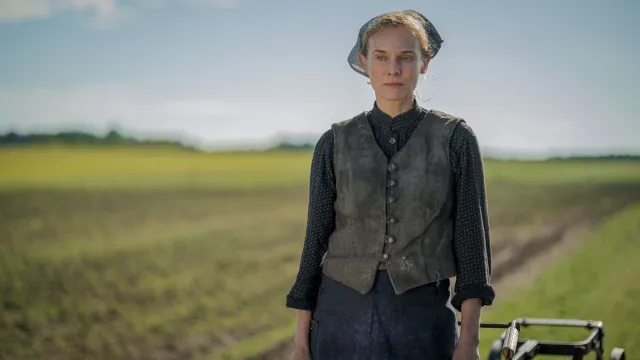
Akin also invited his longtime collaborator Diane Kruger to join the project. He says: “Financing the film was difficult. I sent her the script and told her to choose any role she wanted. I expected her to choose the mother or the aunt, but she said she wanted to play the farmer woman because her own aunt was a farmer similar to that character. I asked her to learn the local Frisian dialect.”
In “Amrum,” Akin relied on the beauty of rugged coastal landscapes and drew inspiration from the 19th-century painter Caspar David Friedrich. Akin says: “It was a way to approach nature with humility. The idea of Romanticism at that time was a return to nature, because industrialization was emerging—steam factories and technology were growing—and artists wanted to retreat into nature. Isn’t the same thing happening today with artificial intelligence? That’s why I studied those paintings that portray nature in an idealized way.”
Ultimately, it was the film that found Akin, not the other way around. He says: “The story came from the outside, and I rediscovered simplicity.”
Kino Lorber will release “Amrum” in theaters on April 17, 2026.